Today’s enterprise technology news arrives in two distinct flavours: infrastructure ambition and security embarrassment.
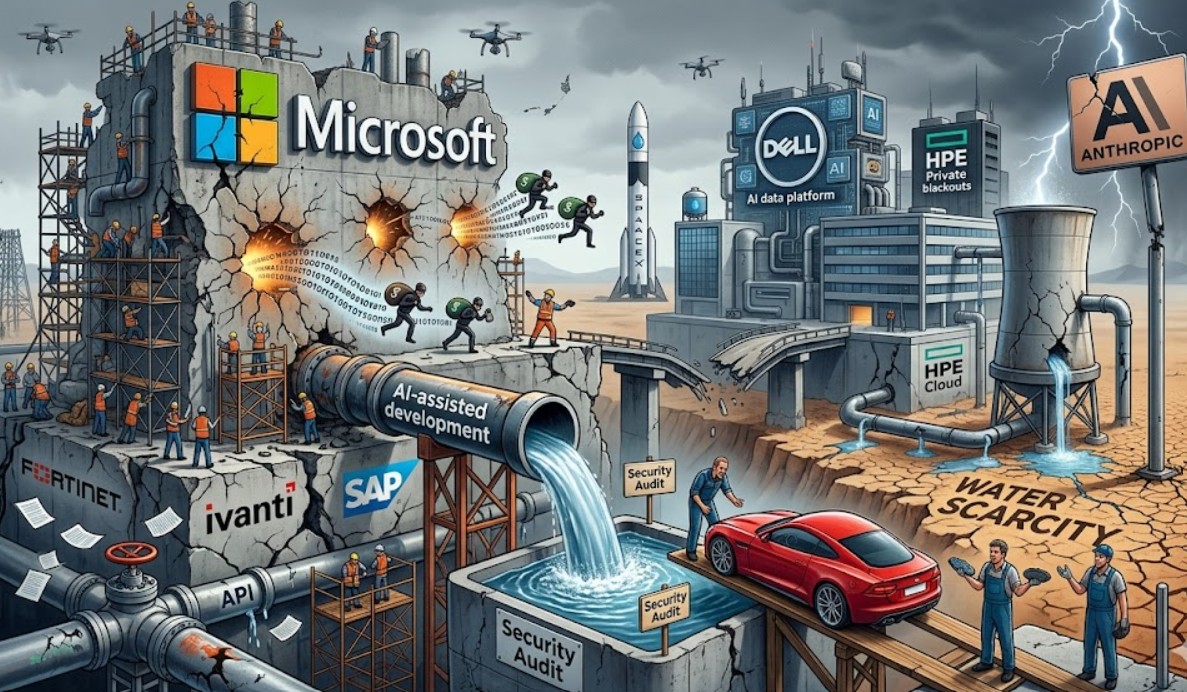
The security story dominates, and not in a good way. Microsoft’s June Patch Tuesday fixed 206 vulnerabilities—including three actively exploited zero-days. That number deserves a moment of quiet reflection. Two hundred and six! Fortinet, Ivanti, and SAP joined the patching parade with critical vulnerabilities of their own, and ServiceNow confirmed a customer data exposure via API misconfiguration. Meanwhile, GitHub removed yet more Microsoft repositories following the credential-stealing worm attack first reported yesterday. At some point, the industry’s collective enthusiasm for AI-assisted development needs to be matched by equivalent enthusiasm for securing it.
Speaking of which: a new study found that 95% of organisations are using AI but only 31% have completed an AI audit. This is the governance equivalent of buying a sports car and skipping the brake check. Not exactly ideal if we’re being honest.
On the infrastructure side, Dell’s Lightning File System for high-throughput AI workloads is a credible production-grade addition to its portfolio. Parallel file systems are not new technology, but Dell entering the space validates mainstream enterprise demand and its vertical integration story—compute, storage, and orchestration under one roof—is genuinely coherent. HPE’s Private Cloud AI expansion is more of the same hybrid cloud narrative the industry has been rehearsing for years.
The Anthropic outage is a useful reminder that betting enterprise workflows on a single AI API provider remains, charitably, optimistic. Multi-provider fallback strategies are not paranoia — they are basic operational hygiene.
And SpaceX flagging water scarcity as a strategic constraint for AI data centre expansion is the most honest thing anyone said today. The industry has been quietly aware of this for some time. Saying it plainly, however, is a start.
Enterprise Technology News Round-Up (11 June 2026)
Enterprise Storage
Dell: Advances AI Data Platform with Lightning File System
Dell expanded its enterprise storage portfolio with a production-ready parallel file system and enhanced AI data platform capabilities. [nand-research.com]
- Introduced Lightning File System for high-throughput AI workloads
- Expanded ObjectScale and AI data orchestration features
- Integrated storage tightly with AI pipelines
Where the announcement states this matters:
- Removes storage bottlenecks in GPU-heavy AI environments
- Improves data pipeline efficiency for training and inference workloads
Objective analysis:
- Parallel file systems are not new (e.g., Lustre, IBM Spectrum Scale), but Dell entering production validates mainstream enterprise demand
- Integration with orchestration layers is an incremental improvement rather than a breakthrough
Assessment of uniqueness:
- Dell’s differentiation lies in vertical integration across compute, storage, and orchestration; however, similar end‑to‑end positioning is being pursued by HPE, NetApp, and NVIDIA partners
Source: NAND Research, May 26, 2026
HPE: Expands Private Cloud AI Deployments for Enterprise Data Platforms
HPE highlighted enterprise adoption of its Private Cloud AI platform to support secure AI development. [hpe.com]
- Enterprises deploying private cloud AI environments
- Focus on secure, air‑gapped AI data processing
- Integration with enterprise data platforms
Where the announcement states this matters:
- Addresses data sovereignty and compliance concerns
- Enables AI workloads without reliance on public cloud
Objective analysis:
- Private AI clouds are already a well-established strategy across vendors
- HPE’s approach aligns with broader hybrid cloud trends rather than redefining them
Assessment of uniqueness:
- Not unique—similar offerings exist from Dell, AWS Outposts, and Azure Stack; differentiation depends on deployment simplicity and ecosystem breadth
Source: HPE Newsroom, June 10, 2026
Cloud Computing
Anthropic: Claude AI Outage Exposes Risks of API-Centric Cloud Architectures
A major outage impacted Claude AI services, disrupting enterprise workflows dependent on the platform. [devflokers.com]
- Claude API, console, and code execution services experienced downtime
- Enterprise automation workflows halted
- Service restored after engineering fixes
Where the announcement states this matters:
- Highlights single-point-of-failure risks in cloud AI platforms
- Impacts enterprise reliance on external APIs for operations
Objective analysis:
- Outages are common in distributed systems; however, dependence on AI APIs amplifies business risk
- Reinforces need for multi-provider or fallback strategies
Assessment of uniqueness:
- Not unique—similar outages have occurred across AWS, Azure, and Google; however, agent-based workflows increase the business impact
Source: DevFlokers, June 3, 2026
SpaceX: Flags Water Scarcity as Strategic Risk for AI Cloud Infrastructure
SpaceX identified water availability as a constraint for scaling AI data centers. [imfounder.com]
- Cooling requirements driving water consumption concerns
- Environmental constraints may limit data center expansion
- Regulatory factors becoming critical
Where the announcement states this matters:
- Links infrastructure growth directly to environmental resources
- Introduces a new constraint beyond compute and power
Objective analysis:
- Validates concerns already raised by hyperscalers regarding cooling efficiency
- Not a new issue but increasingly material at AI scale
Assessment of uniqueness:
- Insight is notable but not unique—Google and Microsoft have previously highlighted similar concerns; SpaceX formalizing it in filings elevates importance
Source: imfounder.com, June 2026
Cybersecurity
ServiceNow: Discloses Customer Data Exposure Incident
ServiceNow confirmed a security issue that exposed customer data via API access vulnerabilities. [hackread.com]
- Unauthorized access to customer data through API flaw
- Security patch released
- Customers notified
Where the announcement states this matters:
- Highlights API security risks in SaaS platforms
- Emphasizes need for stricter access controls
Objective analysis:
- API misconfigurations are a known issue; incident reflects persistent operational gaps rather than new threats
Assessment of uniqueness:
- Not unique—similar breaches are frequent across SaaS vendors; impact depends on data sensitivity and response speed
Source: Hackread, June 10, 2026
Microsoft: Releases June Patch Tuesday Fixing 206 Vulnerabilities
Microsoft issued security updates addressing over 200 vulnerabilities, including three zero-days. [hackread.com]
- 206 vulnerabilities patched
- 3 actively exploited zero-days fixed
- Critical flaws across kernel and network layers
Where the announcement states this matters:
- Demonstrates ongoing volume of exploitable vulnerabilities
- Urges immediate patching across enterprise environments
Objective analysis:
- Large patch volumes are typical; the scale indicates increasing complexity of enterprise software ecosystems
Assessment of uniqueness:
- Not unique—Patch Tuesday regularly includes large numbers; however, multiple zero-days increase urgency and risk level
Source: Hackread, June 10, 2026
Fortinet, Ivanti, SAP: Patch Critical Vulnerabilities
Multiple vendors issued patches for vulnerabilities enabling code execution and data exposure. [thehackernews.com]
- Critical command injection vulnerabilities addressed
- Affected enterprise security platforms and applications
- Patches released across multiple product lines
Where the announcement states this matters:
- Exploitable flaws in security tools increase systemic enterprise risk
Objective analysis:
- Highlights recurring issue of vulnerabilities in security infrastructure itself
Assessment of uniqueness:
- Not unique—frequent occurrence; however, severity is notable due to potential for privilege escalation
Source: The Hacker News, June 2026
GitHub: Removes Microsoft Repositories After Credential-Stealing Worm
A supply chain attack led to removal of multiple repositories. [devops.com]
- Worm exploited developer tooling and AI workflows
- Stole credentials via infected repositories
- GitHub took repositories offline
Where the announcement states this matters:
- Demonstrates growing risk in AI-assisted development environments
Objective analysis:
- Supply chain attacks have been increasing; AI tools expand attack surface
Assessment of uniqueness:
- Not unique, but notable shift toward targeting AI-enabled development pipelines
Source: DevOps.com, June 10, 2026
Data
Enterprises Lag in AI Governance Despite High Adoption
Research shows most organizations lack mature governance despite widespread AI adoption. [esecurityplanet.com]
- 95% of organizations using AI
- Only 31% completed AI audits
- Governance frameworks immature
Where the announcement states this matters:
- Risk of non-compliance and unmanaged data exposure
Objective analysis:
- Confirms known gap between adoption and governance maturity
Assessment of uniqueness:
- Not unique—consistent with prior studies; highlights persistent execution gap
Source: eSecurity Planet, June 2026
IT Automation
Datadog: Extends AI Framework for Automated Issue Resolution
Datadog enhanced its AI capabilities to automate observability workflows. [devops.com]
- AI detects and resolves issues using telemetry data
- Expanded observability automation
- Integrated across DevOps workflows
Where the announcement states this matters:
- Reduces manual incident response effort
- Improves system reliability
Objective analysis:
- Observability automation is an expected evolution; AI improves efficiency but not fundamentally new
Assessment of uniqueness:
- Not unique—similar capabilities exist in Dynatrace and New Relic; differentiation depends on accuracy and integration depth
Source: DevOps.com, June 10, 2026
DevOps
GitLab: Previews AI-Native DevOps Platform Enhancements
GitLab introduced updates focused on managing AI-generated code and workflows. [devops.com]
- New source control capabilities
- AI governance framework
- Tools for managing AI-generated code
Where the announcement states this matters:
- Addresses challenges of AI-generated code quality and compliance
Objective analysis:
- Governance features are expected as AI code adoption grows
Assessment of uniqueness:
- Not unique—GitHub and others are adding similar governance layers; competition will focus on usability and integration
Source: DevOps.com, June 10, 2026
AI
Microsoft: Expands Enterprise AI Agent Platform and Governance Framework
Microsoft introduced a broad set of agentic AI capabilities across its ecosystem. [aguidetocloud.com]
- Launch of Microsoft Foundry agent platform
- Introduction of “Autopilot” class agents (Microsoft Scout)
- New governance and identity framework for agents
Where the announcement states this matters:
- Enables production-grade deployment of AI agents
- Addresses governance, identity, and lifecycle management
Objective analysis:
- Represents evolution from copilots to autonomous agents
- Builds on existing Azure and Copilot capabilities rather than replacing them
Assessment of uniqueness:
- Strong positioning due to integration with Microsoft 365 and Azure; however, competitors (Google, OpenAI) are pursuing similar agent platforms, limiting true uniqueness
Source: Microsoft Build coverage, June 3, 2026
Anthropic: AI Platform Disruption Renews Focus on Reliability
Service outage triggered enterprise concerns around reliability. [devflokers.com]
- Platform downtime affected enterprise users
- Highlighted dependency on centralized AI providers
Where the announcement states this matters:
- Reliability is critical for enterprise AI adoption
Objective analysis:
- Reinforces need for redundancy and hybrid architectures
Assessment of uniqueness:
- Not unique—platform reliability has been a recurring concern across AI providers
Source: DevFlokers, June 2026