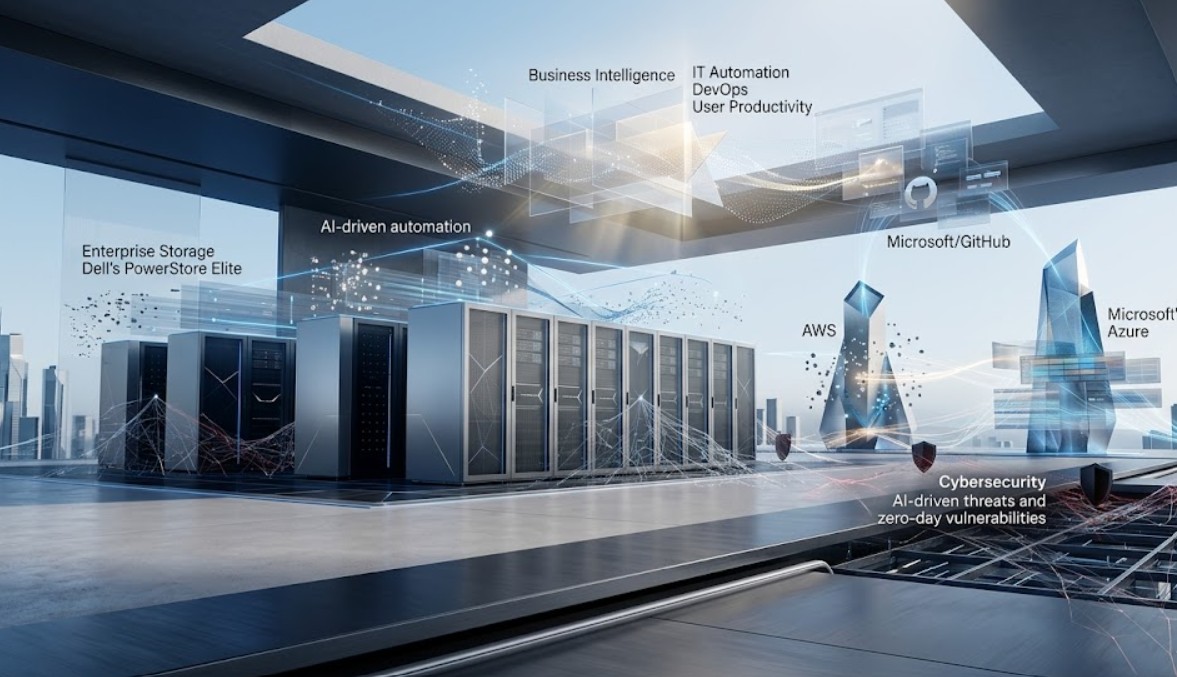
The enterprise tech world is buzzing again, and you’d think its ushering in a revolution of sorts. But what else is new, right? Dell’s shiny new PowerStore Elite promises triple the performance and AI-driven workload balancing, but beneath the gloss it’s largely a hardware refresh—NVMe, CPUs, memory—the usual suspects. NetApp and HPE are hardly quaking in their boots.
AWS, meanwhile, is trying to monetise the AI bot traffic clogging its pipes, rolling out WAF Bot Control and a preview FinOps agent. Clever, yes, but not entirely unique—API gateways have been charging for access for years! Microsoft, never one to miss a branding opportunity, leaned hard into “agentic” cloud at Build 2026, expanding Azure runtimes, container sandboxes, and confidential computing. Strong integration, but again, nothing earth-shattering compared to AWS or Google.
Cybersecurity headlines were predictably grim: zero-days across Windows and Android, AI-powered supply chain attacks, and identity abuse running rampant. Cisco patched an SD-WAN flaw, but that’s business as usual. Data governance remains the Achilles’ heel of AI adoption—95% of firms are deploying AI, yet only 31% have completed audits.
On the productivity front, Microsoft is embedding Copilot deeper into Teams and Outlook, while GitHub Copilot graduates into a control plane for agentic development. AWS continues to bulk up Bedrock with new models and governance tools, though reliability and regulation loom large as the next battleground.
So, no, there’s no ongoing revolution in tech. There is, however, plenty of marketing spin, which again isn’t new.
Enterprise Technology News Round-Up (June 16, 2026)
Enterprise Storage
Dell: PowerStore Elite advances AI-driven storage automation and performance
Dell introduced PowerStore Elite with significant performance and efficiency upgrades aimed at AI-era workloads. [itpro.com], [businesswire.com]
Announcements:
- New storage platform with up to 3x performance and throughput improvements
- AI-driven workload balancing and automation
- Support for mixed workloads (VMs, containers, file/block storage)
- Non-disruptive upgrades and high-density NVMe architecture
Why it matters:
- Enterprises face growing AI data demands requiring high-throughput storage
- Automation reduces operational overhead in storage management
- Unified platforms simplify infrastructure complexity
Assessment of novelty:
- AI-driven tuning builds on existing automation approaches rather than introducing new paradigms
- Performance gains rely largely on hardware refresh (CPU, memory, NVMe), typical of generational updates
- Non-disruptive upgrade capabilities are consistent with prior PowerStore positioning
Leadership/uniqueness claim assessment:
- Claims of “biggest leap” are primarily based on incremental hardware scaling and software optimization
- Comparable capabilities exist in competitor platforms (NetApp, HPE Alletra), limiting differentiation
Source: IT Pro / Business Wire, May–June 2026
Note: No additional enterprise storage stories found within the last 24 hours.
Cloud Computing
AWS: Introduces AI bot monetisation via WAF and previews FinOps agent
AWS launched new capabilities to control and monetize AI bot traffic at the edge alongside cost-management tooling. [aws.amazon.com], [aws.amazon.com]
Announcements:
- AI traffic monetization through AWS WAF Bot Control
- Pricing and access control for AI agents interacting with APIs/content
- Preview of AWS FinOps Agent for cost management
- Continued expansion of Bedrock ecosystem
Why it matters:
- Rising AI bot traffic creates cost and intellectual property concerns
- Enterprises need governance over how AI agents consume APIs/data
- FinOps becomes critical as AI workloads increase cloud spend
Assessment of novelty:
- Bot detection and rate limiting are not new; monetisation is an extension of existing controls
- FinOps agent concept aligns with broader trend of AI-assisted cloud cost optimization
- Enhancements to Bedrock ecosystem are incremental integrations
Leadership/uniqueness claim assessment:
- Monetising AI bot traffic is relatively differentiated at hyperscaler scale
- However, similar API monetisation models already exist (e.g., API gateways), reducing uniqueness
Source: AWS News Blog, June 15, 2026
Microsoft: Expands Azure infrastructure and agentic cloud capabilities at Build 2026
Microsoft expanded Azure compute, orchestration, and AI runtime services to support agentic workloads. [news.microsoft.com]
Announcements:
- New Azure Cobalt 200 VMs optimized for AI workloads
- Azure Container Apps sandboxes for secure agent execution
- Enhancements to AKS, Cosmos DB, and Logic Apps
- Confidential computing and resiliency updates
Why it matters:
- Enterprises increasingly deploy AI agents requiring secure runtime environments
- Infrastructure must support both performance and governance for AI workloads
- Integration across Azure services reduces deployment complexity
Assessment of novelty:
- Many updates are iterative improvements to existing Azure services
- “Agentic” positioning reframes established container, VM, and orchestration capabilities
- Confidential computing enhancements extend ongoing Azure strategy
Leadership/uniqueness claim assessment:
- Microsoft’s integration across data, AI, and infrastructure is strong
- However, core capabilities broadly match AWS and Google Cloud offerings
Source: Microsoft Build, June 2026
Cybersecurity
Multiple Vendors: Surge in AI-driven cyber threats and zero-day vulnerabilities
Recent reports highlight increasing exploitation of AI systems, identity platforms, and supply chains. [esecurityplanet.com], [helpnetsecurity.com]
Announcements:
- Zero-day vulnerabilities impacting Windows, Android, and enterprise systems
- Increase in AI-powered supply chain attacks and malicious models
- Identity-based attacks rising (e.g., Microsoft 365 token abuse)
- Lack of AI governance across enterprises
Why it matters:
- AI expands attack surface across enterprise environments
- Identity systems becoming primary attack vectors
- Governance lag increases enterprise risk
Assessment of novelty:
Attack techniques build on existing vectors (phishing, credential abuse) enhanced by AI
AI supply chain attacks are an emerging but evolutionary trend
Governance gaps reflect organizational maturity rather than new threats
Leadership/uniqueness claim assessment:
- No single vendor demonstrates clear leadership; ecosystem-wide challenge
- Security tooling still lagging behind AI adoption rates
Source: eSecurity Planet / Help Net Security, June 16, 2026
Cisco: Releases patch for actively exploited SD-WAN vulnerability
Cisco issued updates for a vulnerability in Catalyst SD-WAN Manager under active exploitation. [thehackernews.com]
Announcements:
- Patch for CVE-2026-20262 (file overwrite vulnerability)
- Risk of privilege escalation with valid credentials
- Recommendations for immediate patching
Why it matters:
- SD-WAN is widely deployed in enterprise networks
- Exploitation could lead to system-level compromise
- Reinforces importance of patch management
Assessment of novelty:
- Vulnerability type is well-known (input validation flaw)
- Standard patching cycle response from vendors
Leadership/uniqueness claim assessment:
- Not a differentiator; typical vendor response to disclosed vulnerabilities
Source: The Hacker News, June 2026
Data
Industry: AI data governance gap widens as adoption accelerates
Research highlights a mismatch between AI deployment and governance maturity. [esecurityplanet.com]
Announcements:
- 95% AI adoption among organizations
- Only ~31% completed AI audits
- Growing visibility gaps for local AI agents
Why it matters:
- Governance lag introduces compliance and risk exposure
- AI data access often lacks monitoring
- Enterprises risk scaling without control
Assessment of novelty:
- Not a new issue; reflects ongoing governance challenges
- Increased urgency due to rapid AI adoption
Leadership/uniqueness claim assessment:
- No vendor leadership; industry-wide systemic gap
Source: eSecurity Planet, June 2026
(Note: Limited new vendor-specific data platform announcements in last 24 hours.)
Business Intelligence
Industry: Shift toward real-time and AI-driven analytics continues
Analysts highlight rising demand for real-time BI and AI-enhanced insights. [dbta.com]
Announcements:
- Increased focus on real-time analytics pipelines
- Growing reliance on AI for data interpretation
- Evolution of ETL/CDC for faster decision-making
Why it matters:
- Enterprises need faster insights for operational decisions
- AI reshapes data consumption and visualization
- Real-time capabilities become competitive differentiators
Assessment of novelty:
- Trends represent continued evolution rather than new innovation
- Many capabilities already exist in modern BI platforms
Leadership/uniqueness claim assessment:
- Market remains fragmented; no clear dominant innovation leader emerging
Source: DBTA, June 2026
(Note: No major BI vendor announcements identified in last 24 hours.)
IT Automation
Microsoft: Advances agent-based automation across enterprise workflows
Microsoft continues to expand automation capabilities through AI agents and platform services. [dev.to]
Announcements:
- Agent-based automation integrated into development workflows
- Managed runtime and scheduling for automated tasks
- Governance and tracing for automation processes
Why it matters:
- Automation shifts from scripts to autonomous agents
- Governance becomes critical for trust and reliability
- Reduces manual operational workload
Assessment of novelty:
- Evolution of RPA and automation tools into AI-driven forms
- Incremental improvements in orchestration and control
Leadership/uniqueness claim assessment:
- Microsoft leading in integration across productivity and dev platforms
- However, concept of agent automation is widely pursued across vendors
Source: Dev.to (Build 2026 recap), June 2026
DevOps
Microsoft/GitHub: Introduces Copilot app as control plane for agentic development
GitHub Copilot evolves into a centralized environment for managing AI-driven development workflows. [dev.to]
Announcements:
- Copilot app as unified interface for coding, CI/CD, and workflows
- Support for multiple parallel AI agent sessions
- Integration with pull requests, CI checks, and deployment pipelines
Why it matters:
- DevOps workflows becoming more complex with AI agents
- Central control plane improves auditability and governance
- Enables scalable agent-based development
Assessment of novelty:
- Builds on existing Copilot capabilities and CI/CD tooling
- Extends IDE-centric AI into lifecycle management
Leadership/uniqueness claim assessment:
- Strong differentiation in integration depth
- Competitors lack similarly unified agent-development control planes today
Source: Dev.to, June 2026
User Productivity
Microsoft: Expands Copilot and agent integration across Microsoft 365
Microsoft enhances enterprise productivity tools with deeper AI agent integration. [aguidetocloud.com]
Announcements:
- Copilot integration across Teams, Outlook, and workflows
- “Work IQ” providing organizational context for AI agents
- Autonomous agents handling scheduling and tasks
Why it matters:
- AI becomes embedded in everyday enterprise workflows
- Context-aware agents improve productivity and decision-making
- Reduces manual coordination tasks
Assessment of novelty:
- Builds on existing Copilot features rather than introducing new category
- Context-awareness improvements are incremental
Leadership/uniqueness claim assessment:
- Microsoft has advantage due to integration across enterprise apps
- However, competitors (Google Workspace, Slack AI) pursuing similar strategies
Source: Microsoft Build recap, June 2026
AI
AWS: Expands Bedrock ecosystem with agents, models, and governance features
AWS continues to build out its enterprise AI platform with new capabilities and integrations. [aws.amazon.com]
Announcements:
- Preview of FinOps agent
- New model availability (e.g., Claude Fable 5)
- Enhanced Bedrock console for model comparison and deployment
Why it matters:
- Enterprises require unified access to multiple AI models
- Governance and evaluation tools critical for production AI
- Multi-model strategies becoming standard
Assessment of novelty:
- Marketplace-style model access already established
- Improvements are largely UX and integration enhancements
Leadership/uniqueness claim assessment:
- AWS strong in enabling multi-model ecosystems
- Differentiation lies in scale rather than unique capabilities
Source: AWS Blog, June 15, 2026
AI infrastructure constraints and operational risks come into focus
New analysis highlights infrastructure, reliability, and regulatory risks in enterprise AI adoption. [devflokers.com]
Announcements:
- AI service outages impacting enterprise workflows
- Increased regulatory scrutiny on AI deployment
- Rising infrastructure dependency risks
Why it matters:
- Enterprises depend on AI platforms for operations
- Reliability becomes a critical purchasing factor
- Regulatory compliance shapes deployment strategies
Assessment of novelty:
- Issues reflect maturity phase of AI adoption rather than new breakthroughs
- Infrastructure challenges have been known but are now more visible
Leadership/uniqueness claim assessment:
- No vendor clearly solving these issues comprehensively
- Competitive differentiation likely to emerge around reliability and governance
Source: DevFlokers, June 2026