
Summary
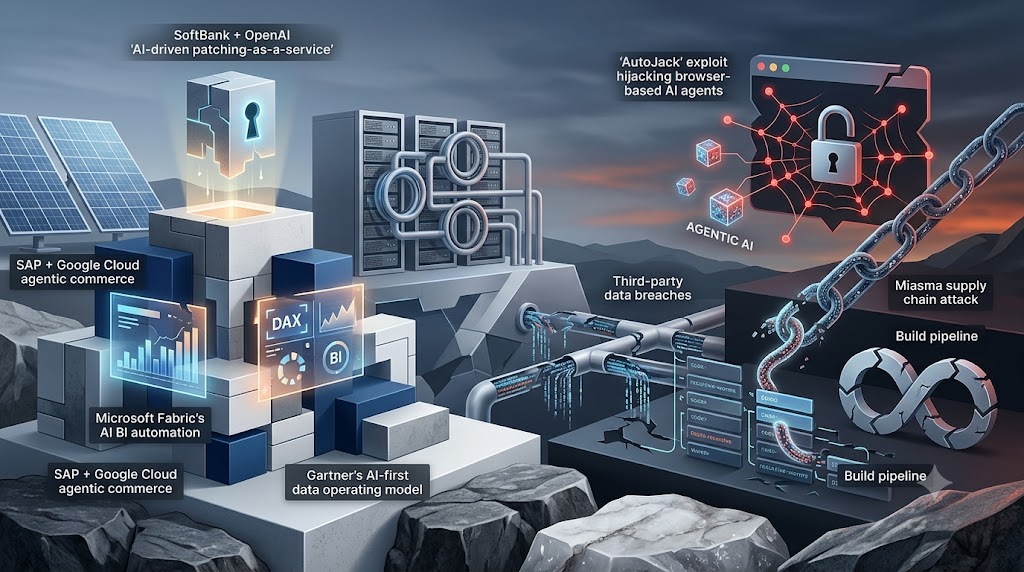
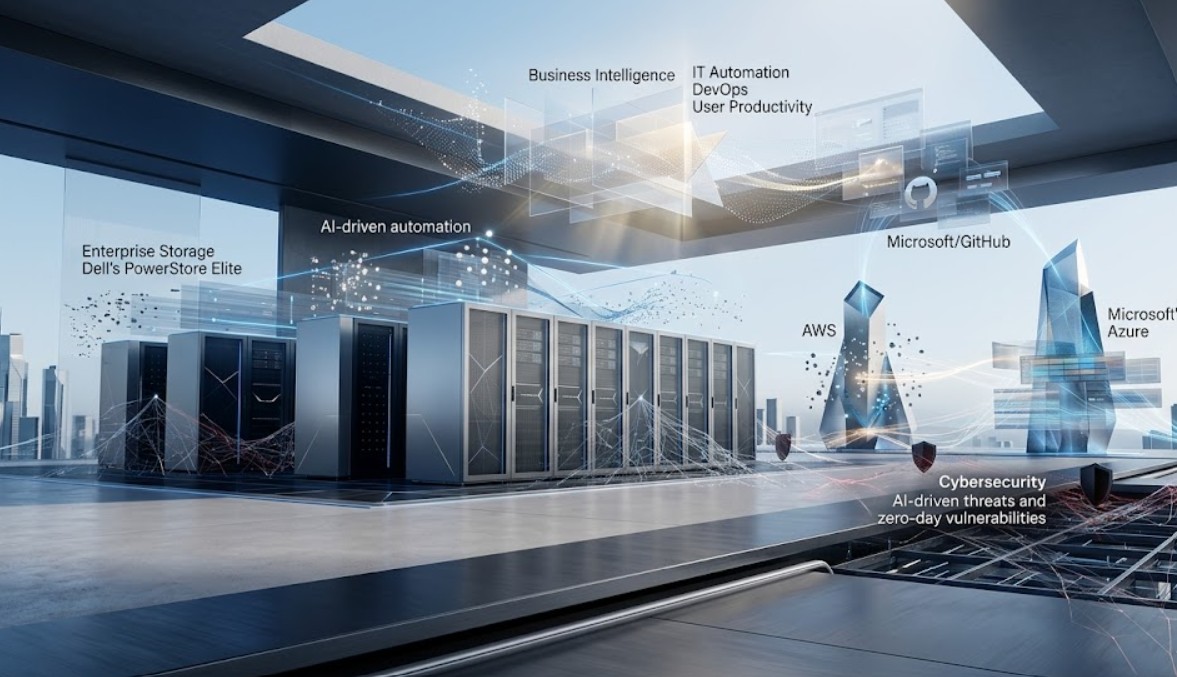
The past 24 hours in enterprise technology highlight a decisive shift from experimentation toward operationalising agentic systems at scale. Vendors across cloud, data, infrastructure, and productivity platforms are embedding autonomy directly into core workflows, reframing AI not as an assistant layer but as an execution layer that must be governed, secured, and economically managed.
Microsoft Build 2026 dominated headlines with production‑grade components such as Work IQ APIs, Rayfin, and expanded agent governance, signalling a maturing strategy focused on infrastructure and control rather than end‑user novelty. Google Cloud and Snowflake countered with data‑centric announcements, while hardware vendors at Computex underscored how power density and cooling are now first‑order constraints for AI leadership.
Cybersecurity reporting struck a cautionary note, warning that most production AI agents fail basic maturity checks, while BI, IT automation, and productivity vendors revealed a consistent pattern: autonomy is being embedded into existing platforms, not launched as standalone products.
Together, these developments suggest the next phase of enterprise AI competition will be fought on integration depth, operational trust, and sustainability—rather than raw model capability.
Enterprise Technology News Round‑Up (4 June 2026)
Enterprise Storage
Google Cloud: Expands High-Performance Storage Capabilities for AI Workloads
Summary:
Google Cloud announced enhancements to its enterprise storage stack aimed at supporting AI training and inference pipelines, including new high-performance tiers and tighter AI integration.
What was announced:
- New “Rapid” performance capabilities for Cloud Storage object workloads
- Performance and cost enhancements to Google Cloud Managed Lustre
- Automated metadata tagging for unstructured enterprise data
- Direct connectivity between storage services and AI agents
Why it matters:
- AI accelerators are frequently under-utilised due to storage bottlenecks.
- Storage increasingly acts as the context layer for AI agents, not just persistence.
- Enterprises need predictable performance without moving data into separate AI silos.
What’s genuinely new:
- Performance tuning and tiering are incremental, not novel.
- Metadata enrichment tied to AI agents is an extension of existing analytics features.
Assessment of uniqueness claims:
- Google is credible in large-scale performance engineering.
- However, equivalent object-storage acceleration strategies exist at AWS and Azure.
- This is competitive parity, not a step-change in storage leadership.
Source: Google Cloud Blog, 3 June 2026 [cloud.google.com]
Cohesity: Secures Patent for GenAI Retrieval on Secondary Data
Summary:
Cohesity announced it has been granted a US patent covering retrieval-augmented generation (RAG) applied directly to secondary (backup) data systems.
What was announced:
- Patent covering embeddings and retrieval over backup data
- Validation of the Gaia GenAI architecture
- Ability to run AI queries without copying sensitive data
Why it matters:
- Backup data represents a large, under-used enterprise knowledge base.
- Avoiding data movement reduces security and compliance risk.
- Makes AI access feasible in regulated environments.
What’s genuinely new:
- RAG itself is not new.
- Applying it natively to backup systems with governance intact is materially different.
Assessment of uniqueness claims:
- Cohesity’s “first data protection vendor” claim holds up narrowly.
- This is defensible architectural differentiation, not marketing spin.
Source: PR Newswire, 3 June 2026 [tirto.id]
Cloud Computing
Microsoft: Work IQ API Reaches General Availability
Summary:
Microsoft confirmed that Work IQ APIs will reach GA on 16 June, enabling developers to build AI agents grounded in Microsoft 365 context using consumption-based pricing.
What was announced:
- GA of Work IQ APIs
- Pay-as-you-go billing via Copilot Credits
- Programmatic access to emails, meetings, documents and work signals
Why it matters:
- Agents can now reason over live workplace context.
- Moves Copilot intelligence into custom enterprise applications.
- Shifts AI cost management from per-user to workload-based.
What’s genuinely new:
- Capabilities existed internally for Copilot.
- Opening them as APIs is a meaningful platform shift.
What’s genuinely new:
- Microsoft’s advantage comes from data surface breadth.
Assessment of uniqueness claims:
- Not unique in concept, but difficult for competitors to replicate at this scale.
Source: Microsoft Learn, 3 June 2026 [learn.microsoft.com]
LITEON: Introduces 800V DC Liquid-Cooled Power Rack for AI Data Centres
Summary:
LITEON debuted an 800V DC liquid-cooled power rack designed for megawatt-scale AI infrastructure.
What was announced:
- 800V DC power architecture
- Direct-to-chip liquid cooling
- Designed for NVIDIA MGX platforms
Why it matters:
- Power delivery is now a primary AI scaling constraint.
- Higher voltage improves efficiency at rack density extremes.
What’s genuinely new:
- 800V DC is an emerging industry direction.
- LITEON is early, but not alone.
- Leadership depends on ecosystem adoption.
Assessment of uniqueness claims:
- Technically credible, but not yet a de-facto standard.
Source: TMCnet, 3 June 2026 [tmcnet.com]
Cybersecurity
Industry: Only a Minority of Production AI Agents Meet Security Maturity Standards
Summary:
Multiple security analyses reported that fewer than 15% of deployed AI agents meet basic governance and security thresholds.
What was announced:
- Widespread lack of agent identity controls
- Weak memory and tool-access governance
- Limited monitoring of autonomous execution
Why it matters:
- Autonomous agents amplify risk faster than human-in-the-loop AI.
- Security gaps scale non-linearly with agent count.
What’s genuinely new:
- This is a new class of risk, not traditional app security.
Assessment of uniqueness claims:
- No vendor demonstrates clear leadership yet.
- Market is early, fragmented, and reactive.
Source: Help Net Security, 3 June 2026 [helpnetsecurity.com]
Microsoft: Publishes Guidance on Securing AI Agents and Models
Summary:
Microsoft outlined emerging security challenges around AI agents, including prompt injection and identity sprawl.
What was announced:
- New threat models for agent behaviour
- Detection rules and mitigation guidance
Why it matters:
- Signals acknowledgement that agents require new security thinking.
What’s genuinely new:
Advisory content, not new tooling.
Assessment of uniqueness claims:
- Thought leadership is credible.
- Product-level differentiation remains limited.
Source: Help Net Security, 3 June 2026 [helpnetsecurity.com]
Data
Snowflake: Positions AI Data Cloud as Shared Enterprise Context Layer
Summary:
At Snowflake Summit coverage, executives reinforced Snowflake’s positioning as a shared semantic and context layer for enterprise AI.
What was announced:
- Emphasis on common enterprise semantics
- Agent access to governed business data
Why it matters:
- AI agents fail without shared business meaning.
What’s genuinely new:
- Conceptual framing rather than new services.
Assessment of uniqueness claims:
- Strong execution credibility.
- Similar positioning emerging from Microsoft Fabric.
Source: diginomica, 3 June 2026 [bing.com]
Zifo: Demonstrates Biobank-Scale Lakehouse Architecture
Summary:
Zifo showcased an enterprise data platform capable of querying 100+ billion genomic records using Apache Iceberg.
What was announced:
- Large-scale lakehouse architecture
- Sub-second query performance
Why it matters:
- Shows data engineering, not AI models, is the limiting factor.
What’s genuinely new:
- Scale and optimisation are notable.
- Domain-specific rather than general purpose.
Assessment of uniqueness claims:
- Leadership confined to life sciences data.
Source: PR Newswire, 3 June 2026 [finance.yahoo.com]
Business Intelligence
Accenture & AlphaSense: Partner on Agentic Market Intelligence
Summary:
Accenture announced an investment in AlphaSense to embed market intelligence directly into agent workflows.
What was announced:
- Strategic investment
- Integration of insights into autonomous workflows
Why it matters:
- BI shifts from dashboards to execution.
What’s genuinely new:
- Integration model is new.
- Core data sources unchanged.
Assessment of uniqueness claims:
- AlphaSense remains strong in financial content.
- Not a universal BI platform.
Source: Accenture Newsroom, 3 June 2026 [newsroom.a…enture.com]
IT Automation
OpenAI: Expands Codex to Non-Developer Enterprise Roles
Summary:
OpenAI introduced Codex Sites and role-specific automation plugins for business users.
What was announced:
- Hosted web apps built via natural language
- Pre-bundled business automation skills
Why it matters:
- Lowers automation barriers beyond IT teams.
What’s genuinely new vs repositioned:
- Packaging and distribution are new.
- Automation primitives already existed.
Assessment of uniqueness claims:
- Ecosystem reach is the differentiator.
- Functionality is increasingly commoditised.
Source: explainx.ai, 3 June 2026 [explainx.ai]
DevOps
Flosum: Enhances Salesforce Backup and Compliance Controls
Summary:
Flosum updated its Salesforce DevOps backup platform with legal hold and faster recovery.
What was announced:
- Legal hold features
- 60% faster restore times
Why it matters:
- Salesforce data faces increasing regulatory scrutiny.
What’s genuinely new:
- Legal hold is meaningful.
- Performance gains are incremental.
Assessment of uniqueness claims:
- Strong in Salesforce niche.
- Not broadly applicable across DevOps.
Source: GlobeNewswire, 3 June 2026 [finance.yahoo.com]
User Productivity
Meta: Launches Business Agent Platform Across Messaging Apps
Summary:
Meta launched Business Agent and an associated platform to automate customer interactions across WhatsApp, Messenger and Instagram.
What was announced:
- AI agents for customer service and sales
- Platform for scaling and customisation
Why it matters:
- Embeds automation directly into frontline business channels.
What’s genuinely new:
- Expansion of existing automation tools.
Assessment of uniqueness claims:
- Leadership is driven by user scale.
- Functional depth remains narrower than enterprise platforms.
Source: Meta Newsroom, 3 June 2026 [about.fb.com]
AI
Microsoft: Introduces Rayfin as Backend Platform for AI Applications
Summary:
Microsoft unveiled Rayfin, an open-source backend platform for building AI applications on Microsoft Fabric.
What was announced items:
- Open-source SDK
- Simplified backend deployment for AI apps
Why it matters:
- Reduces friction in deploying governed AI services.
What’s genuinely new:
- Consolidation of existing Fabric capabilities.
Assessment of uniqueness claims:
- Strength lies in integration and governance.
- Backend patterns themselves are not novel.
Source: Windows Report, 3 June 2026 [bing.com]